Friday, June 1, 2012

Previous posts on the elements that form the building envelope, have shown Intello humidity variable airtightness membranes.  The management of the membrane has needed to be considered to position it in the correct place on the inner face of the construction.  Once the insulation is all in place, the membrane is taped sealing all joins. Once complete, the building is closed up and a blower-door test is undertaken to ensure the building meets the criteria for airtightness required by Passivehouse standards.  Note that all services the penetrate the membrane are taped to ensure airtightness.


The blower door

Previous blower door tests have not quite met the requires air change per hour (ac/h) required to meet the  minimum Passive House standard of 0.6ac/h, so a few  adjustments are made to address the building envelope.  Additional blower tests are done until this is achieved.
A ply panel with seals for the blower fan is fitted into the internal garage door that provides direct access to the house entry foyer .


Fitting of the panel for the blower door can be seen in the garage.


The fan unit

Thursday, May 24, 2012

WET AREAS

17 comments
Wet areas within the house have water-proofing membranes applied.  The walls have user -friendly and environmentally safe 'duroSET' - which is a single pack latex membrane waterproof membrane  applied prior to the tiles being installed.


Gibralter Board ('GIB® Board') is a gypsum and paper board, commonly used to line walls and ceilings.  The GIB®  range of products can also provide for wet areas, bracing, noise reduction.  'GIB® Board'  has been fixed to 'Rondo' galvanised steel battens applied to both walls and ceiling to minimise thermal bridging.  The board is fixed horizontally to maximise sheet lengths, and reduce the number of joints that need to be plastered.
 It will be plaster finished ready for a paint finish.


The Rondo Battens are installed vertically, with timber boards along the bottom edge fixed bottom plate of the timber framed wall to minimise bridging meanwhile providing for fixing of the bottom edge of the GIB® plaster board wall lining panels.  Fibreglass 'Batts' are fitted between the battens of the walls of the buildings external envelope. The grey protrusion provides for future grilles for the HRVS system.


Withing the large ceiling of the Living Area, movement joints have been allowed, hence the wider gap between the GIB® plaster board lining the ceiling.  The perpendicular slot provides for a lighting track.


It can be seen in the picture above that the wall linings now cover the concrete block walls at the end of the Living Space.


The main bedroom has a higher density GIB plaster board lining
 on the ceiling for additional sound-proofing.


Holes are cut into the wall linings to enable services to be introduced 
into the room space from within the wall cavities.


The plaster wallboard lining panels have their joins and fixings plastered over, and sanded ready for a paint finish.  Resene paints are applied specific to individual situations. 


Tuesday, May 15, 2012

WIRING

4 comments
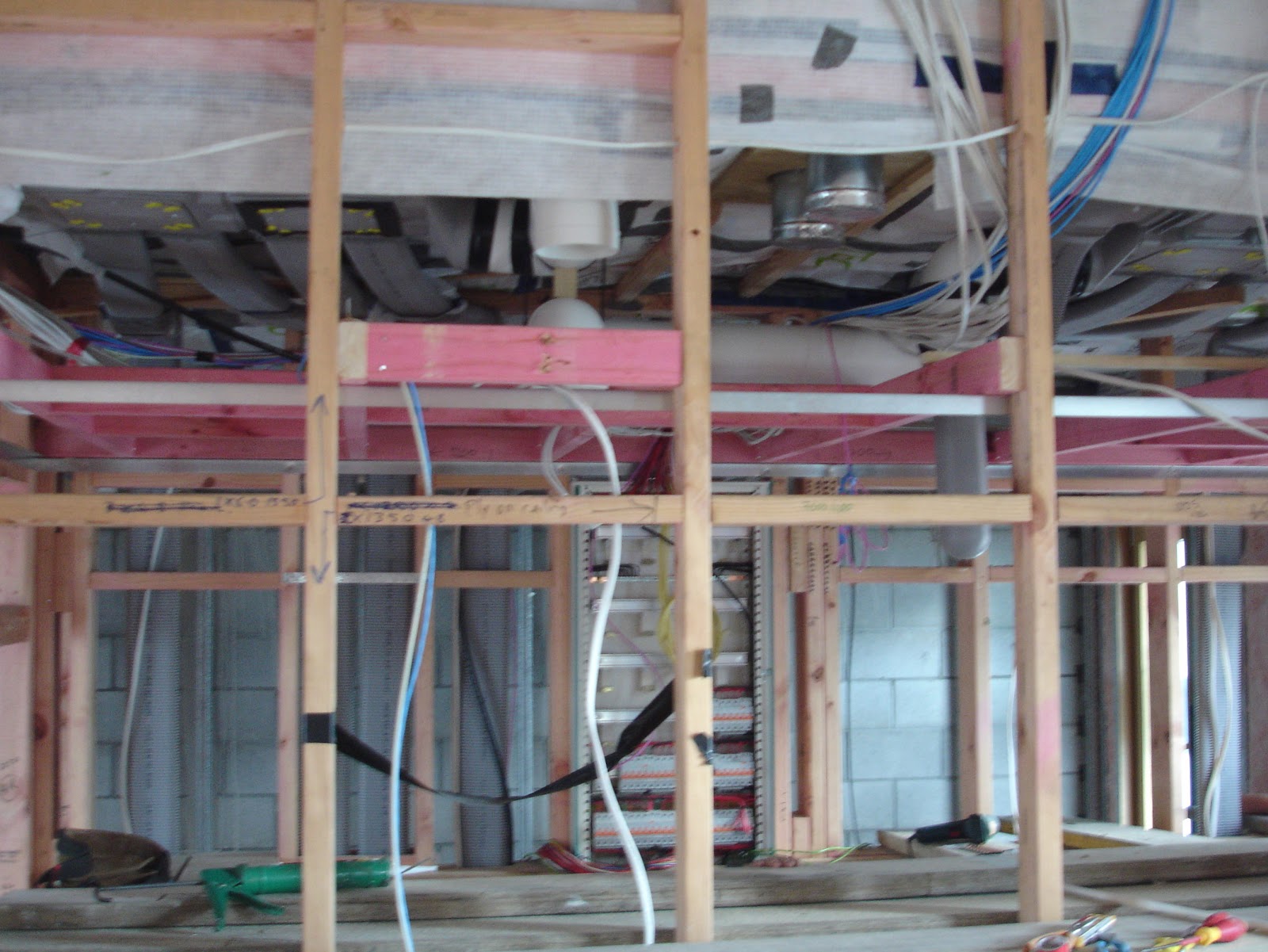
Wiring for the house is being threaded through walls and ceilings to facilitate the needs for each space / room.  The wires are taped to the surface they protrude through to ensure airtightness is not compromised.


The wiring boxes are set into individual timber frames to prevent thermal bridging.  When using Intello membrane, the wiring boxes would be usually be taped to seal the junction between the box and the membrane - but in this case Rondo metal battens have been installed to enable a secondary layer of insulation and the Intello membrane is sandwiched between the two layers of insulation.